
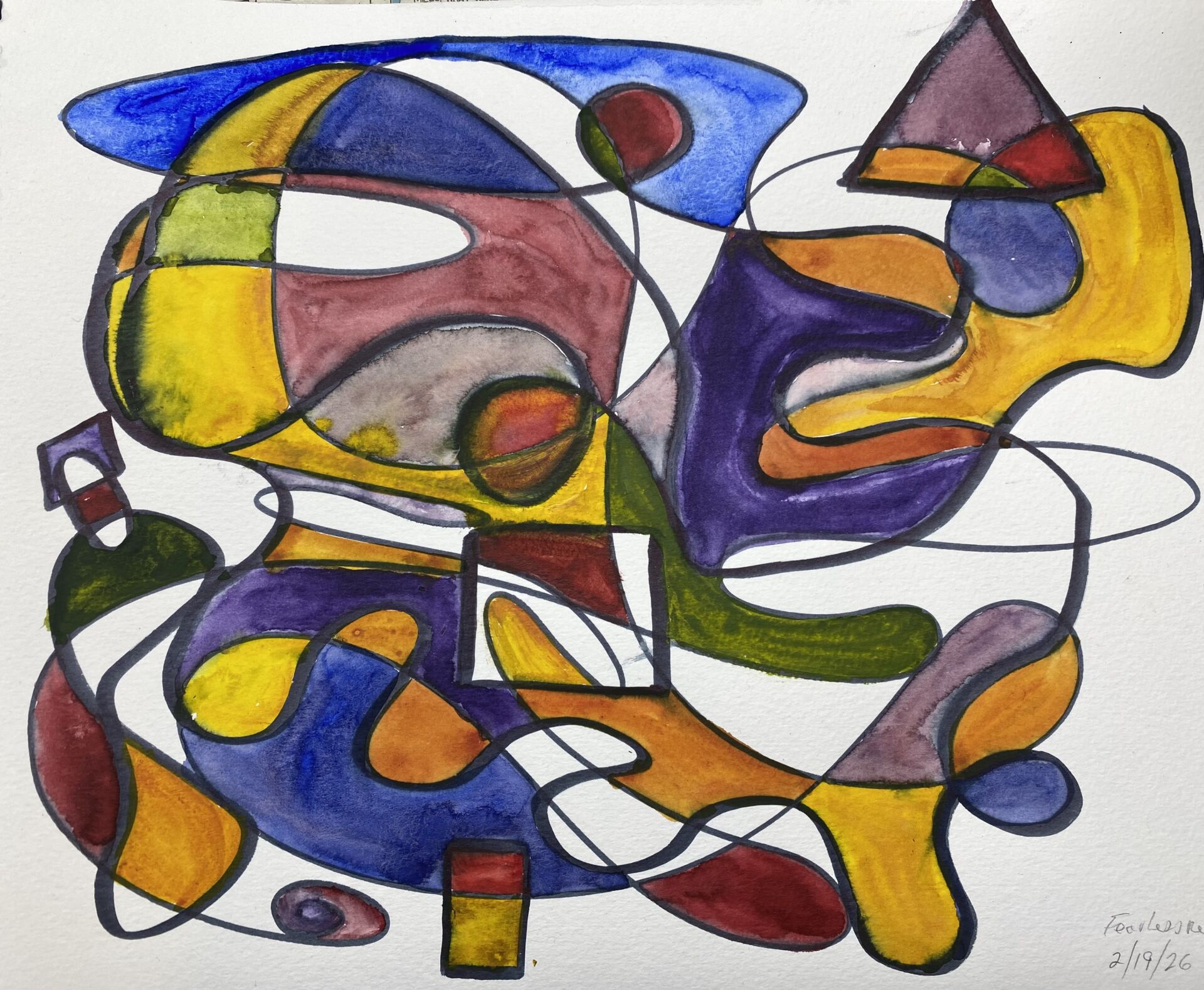
Fearlessness, intuitive art from my sketchbook, watercolor and permanent marker on paper. 2026.
Recently during an online art workshop, I had what might be called a counter-intuitive experience. It got me thinking about what “counter-intuitive” means in practice. The word literally means “against intuition,” but in my lifetime relationship with my intuition, it’s clear that “counter-intuitive” nudges that come from within are almost never against intuition at all.1 “Counter intuitively” counter-intuition often comes directly from the intuition, and occurs when intuition is leading towards something that goes against what is expected, against the brain, or against what “makes sense.” Intuition — in art and life — is often able to lead us when analysis fails.
In this recent case, the pull of the workshop group was excitement over a shared experience, and a strong impulse to join community, either through the extended course that was being offered, or through joining the group’s online community. I was already connected to the same online community, and had found it very helpful in my growth as an artist. Yet, my counter-intuitive moment was a strong sense that it was time to step into a different kind of community, and out of the one connected with the workshop. To make matters worse, the sense came without my knowing exactly where that new community might be.
Many years ago when I was facing a difficult decision, a close friend of mine gave me some wise advice: picture yourself in the future having chosen each of the different choices, and the future scenario in which you find peace, choose that. The advice isn’t perfect. I’m an analyst by training and nature, so I tend to dissect opportunities and choices, look at pros and cons, etc. But sometimes there is no best choice, and sometimes the right choice for me is not the analytically best choice, because analysis is what makes “sense,” and what “makes sense” is influenced by what society expects. But what if the right choice is an unexpected path? I applied the test to leaving the community or staying, and knew it was time to go.
Intuition in Life
I had a similar experience when I moved back to Virginia after nearly a decade away, having first lived in China, and then Kansas. I was considering two locations for my new home in Virginia: my home town of Charlottesville and Northern Virginia where I had lived for over a decade. Every time I thought about it, Northern Virginia made sense, I was working for a non-profit, and all the donors I had cultivated were in Northern Virginia. I also had many deep long-standing friendships still in Northern Virginia. Some friends there invited me to stay in their guest room for as long as I needed.
Charlottesville on the other hand didn’t make sense at all. I hadn’t lived there in decades. I had lost touch nearly all my friends there, and many of them had moved away themselves. My primary reason for moving back to Virginia was because I had been profoundly lonely in Kansas with what felt like very shallow and transactional friendships (there were some wonderful exceptions of course. I never would have made it that long if not). My mother was in Charlottesville, but she and her friends were really my sole remaining connection. My mother also invited me to stay in her guest room as long as I needed to get settled. Charlottesville didn’t make sense at all from a professional or social perspective (except it was a little cheaper), but I couldn’t shake a feeling about it as a possibility.
Because my work allowed me to work remotely, I decided to split my time between the two guest rooms. I stayed in Northern Virginia for weeks on end, and then when it felt right, I’d travel to Charlottesville and stay there for a time until I was ready to travel back to Northern Virginia. Every time I was in Charlottesville I experienced a counter-intuitive sense of rightness. Every time I was in Northern Virginia, I enjoyed connecting with friends, but felt a longing to be back in Charlottesville.
Eventually, circumstances opened up for an affordable apartment in Charlottesville, and it was time to decide. By that time, I knew. Though it was completely counter-intuitive, I rented the apartment and did not look back. Within a few months of renting the apartment, I reconnected with some old acquaintances from two decades previous. One had been only slight acquaintance back then, but we soon became close friends. A year later, he asked me out. Two and a half years years after that, we got married, and have been happily married for nearly 14 years now.
All this is to say that counter-intuition is intuition. If intuition didn’t feel counter-intuitive, it would just be common sense. It is those moments when we just know we have to do something, even if we don’t understand why, that often lead us to the greatest fulfillment. Counter-intuition feels risky. It feels like that leap of faith. We do something not knowing how it will turn out. But the truth is even when choose the less “risky” road, we still don’t know how it will turn out. The less risky road may lead to stagnation or missed opportunities. What “makes sense” may be the completely wrong path.
Intuition in Art
All this applies to art as well. Every creative breakthrough I’ve experienced has required counter-intuitive actions. When I make a beautiful graceful pot on the wheel, it feels very risky to alter it. I must risk ruining it. I can’t tell the times in a community art space that I made a pot I was planning to alter, and nearly got talked out of it by fellow ceramists who liked the shape. The problem was I liked the shape too, and I was risking what I’d already done to experience something I didn’t know for sure would work.
I also experienced counter-intuition when I hadn’t painted seriously in decades, but my intuition kept telling me to paint. Picking up a brush and making some awkward painting feels incredibly uncomfortable. Likewise, making something abstract feels weird if you don’t normally do that. If you make a drawing you love, but decide to add color, the color may feel risky, and it is risky. In all these cases you could ruin it. The thrill of art is in the risk. Even if the final doesn’t turn out, the learning is invaluable.
I’ve decided that to be a maker (or at least to be the kind of maker I want to be), I must be in love with the thrill of following my intuition more than anything else. I must love the flow of creating more than a career in art, selling my art, any external validation, or even the success or failure of the specific creative act in front of me. I must love my intuition enough to be willing to make mistakes, even big ones. In short, I must embrace living the counter-intuitive life.
Questions for reflection:
- How have you experienced intuition in art? In life? What counter-intuitive actions are you currently considering in your creative process or life?
- Take a moment to picture yourself having taken the counter-intuitive step and not taking it. What does each decision feel like inside?
[1] There is another usage of counter-intuitive, in which someone tells you something that doesn't seem like it would work or be correct. Our first impulse is not always correct. This essay is not about when provable facts go against what our natural instinct or impulse tells us. Instead I'm examining the limits of analysis and what an inward counter-intuitive sense may have to teach us when there is no provable "right" way. ↩


Leave A Comment